
Article: Best Personal Safety Alarms for Runners (2026 Guide)
Best Personal Safety Alarms for Runners (2026 Guide)
Let me tell you what I tell every woman at every safety workshop I speak at: the best safety alarm is the one you'll actually carry.
I've spoken at The Running Event's Female Runner Safety Summit and NYRR workshops, and the question I get most often isn't "should I carry an alarm?" It's "which one won't get in my way?"
Because here's the truth — most personal alarms weren't designed by people who run. They were designed to sit in a purse. And a purse alarm on a 6-mile run is an alarm you leave at home.
So let's break down what actually matters when you're choosing a safety alarm for running.
What Makes a Safety Alarm Actually Work for Runners
1. It has to be loud enough to matter — 130dB is the benchmark
A whisper is about 30 decibels. A lawnmower is 90. A jet engine at takeoff? Around 140.
You want an alarm at 130dB or higher. At that level, the sound is physically hard to ignore, carries across a park or parking lot, and — this is the important part — creates immediate attention. Attackers rely on quiet. An alarm takes that away in one pull.
Anything under 120dB is more keychain toy than safety tool. Check the spec before you buy.
2. It has to activate in one motion
Mid-run, your hands are sweaty, your heart rate is up, and if something feels wrong, you have seconds — not time to find a tiny button. Look for a pull-pin activation: grab, pull, done. No fumbling, no unlocking, no "wait, which button?"
3. It has to attach to what you're already wearing
This is where most alarms fail runners. If it lives in your pocket, it's not reachable. If it bounces on a lanyard, you'll ditch it by mile two.
The best setup is an alarm that clips directly to your waistband, sports bra strap, or leggings pocket — somewhere your hand naturally falls.
4. Rechargeable beats replaceable
Battery-powered alarms have a sneaky failure mode: the battery dies quietly, and you find out at the worst possible moment. A USB-C rechargeable alarm you top off like your earbuds is one less thing to think about.
5. Bonus: a built-in flashlight
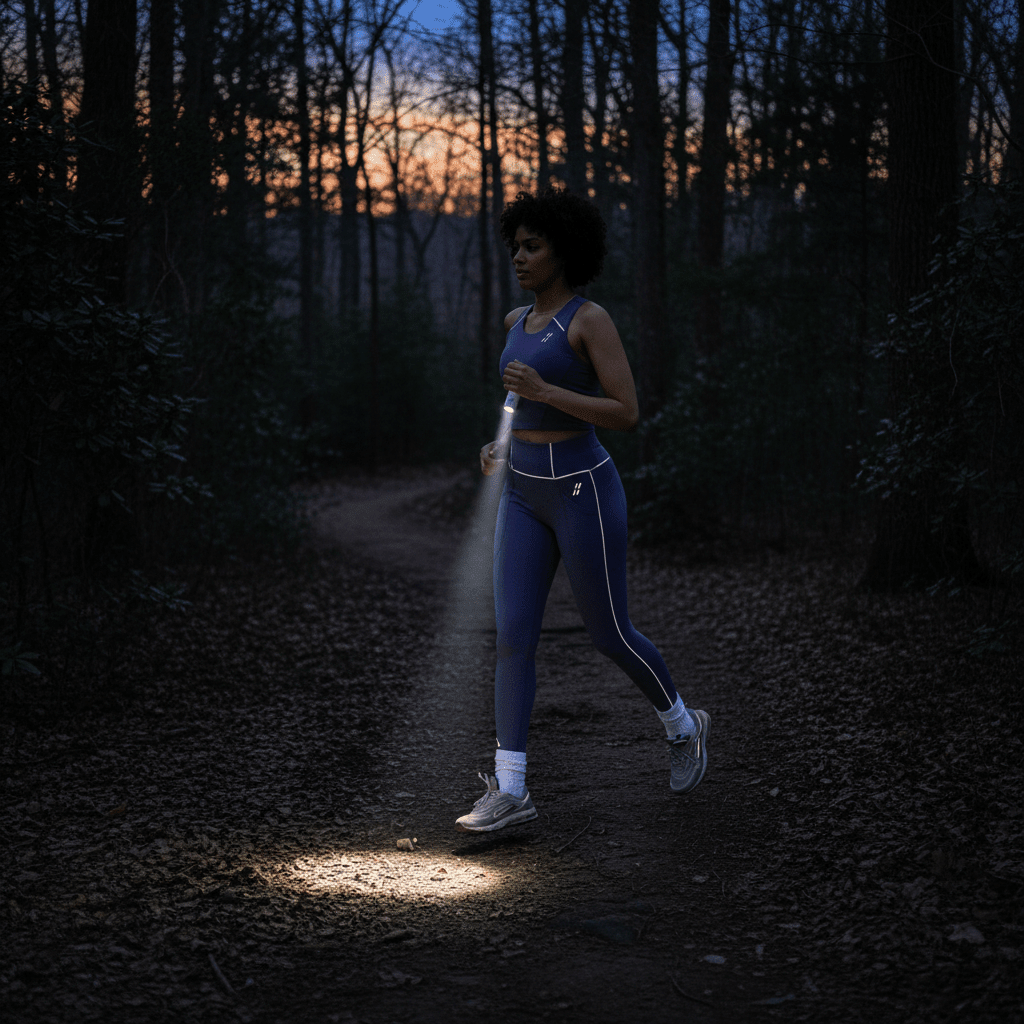
If you run early mornings or after work in the winter, a small LED flashlight on your alarm pulls double duty — checking your path, being seen at crosswalks, finding your keys at your car.
Our Pick: The Flutter Safety Alarm
I'm biased, but I'm biased for a reason — I built the Flutter Safety Alarm because nothing on the market checked every box for the women in my run community.
Here's what it delivers:
- 130dB siren — loud enough to be heard across a parking deck
- One-pull activation — grab the pin, pull, instant sound
- USB-C rechargeable — no batteries, ever
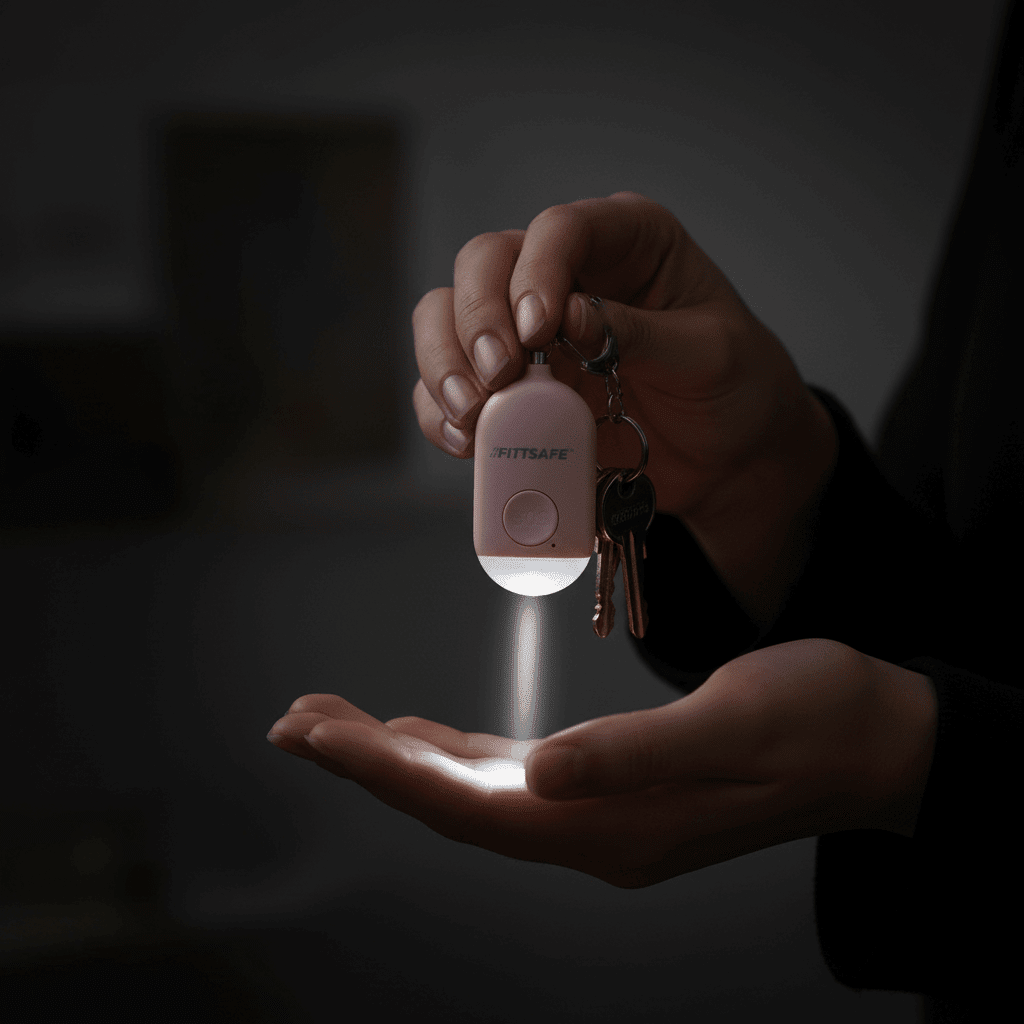
- Built-in LED flashlight — for pre-dawn miles
- Light and clip-ready — designed to pair with the safety pockets in our sports bras and leggings
It's $21.99. Less than a race entry fee, and it comes with you on every single run.
Safety Alarm vs. Pepper Spray vs. Phone: Which Should You Carry?
Honest answer? An alarm wins for most runners, and here's why:
| Safety Alarm | Pepper Spray | Phone | |
|---|---|---|---|
| Works at a distance | ✔ Yes | ✘ Close range only | ✔ But slow |
| Legal everywhere | ✔ Yes | ✘ Restricted in some states/venues | ✔ Yes |
| Works if you're grabbed | ✔ One pull | ✘ Requires aim | ✘ Requires unlocking |
| Can be used against you | ✔ No | ✘ Yes | — |
| Race-day friendly | ✔ Yes | ✘ Often banned | ✔ Yes |
Pepper spray requires aim, close range, and favorable wind — and it's banned at most races. Your phone requires unlocking and dialing under stress. An alarm asks one thing of you: pull.
Carry your phone anyway. But make the alarm your first line.
How to Carry an Alarm on a Run (So You'll Actually Use It)
- Clip it where your hand naturally falls — waistband or bra strap, not a back pocket
- Practice one pull at home — muscle memory matters more than the gear
- Charge it on Sundays — pair it with your long-run routine
- Tell your run crew you carry one — normalize it; safety is a group habit
FAQ: Safety Alarms for Runners
How loud is 130dB, really?
Louder than a rock concert, about the level of a military jet takeoff heard from the runway. It's designed to be impossible to ignore and painful to stand next to.
Are personal safety alarms legal?
Yes — in all 50 states, on planes (in carry-ons), on campuses, and at races. That's a major advantage over pepper spray.
Will it go off accidentally in my bag?
Pull-pin alarms like the Flutter require a deliberate pull, so accidental activation is rare — unlike button-style alarms.
How long does the alarm sound?
Until you reinsert the pin — which also means an attacker can't easily silence it.
Do safety alarms actually deter attackers?
Attackers depend on isolation and silence. A 130dB siren removes both instantly and draws every eye within earshot. No tool is a guarantee — but an alarm changes the situation in your favor in one second.
The Bottom Line
You train your body for the miles. Train your safety routine the same way — simple, repeatable, always with you.
Shop the Flutter Safety Alarm — $21.99 →
And if you want your alarm and your apparel working together, check out our sports bras with built-in safety pockets — designed so your Flutter is always one reach away.

Leave a comment
This site is protected by hCaptcha and the hCaptcha Privacy Policy and Terms of Service apply.